Wall Street closes at a record for the first time since end of January
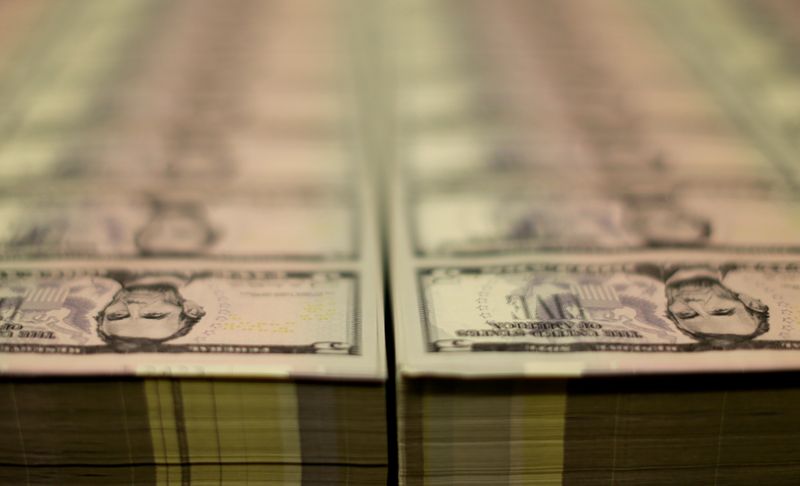
Investing.com -- The U.S. dollar hovered around six-week lows on Wednesday, as risk appetite continued to improve on hopes of a prolonged ceasefire in the Iran war.
The continued pivot by investors into risky assets such as equities over the last few weeks has weighed on the dollar, which has become a safe haven asset of choice during the ongoing Middle East conflict.
At 16:57 ET (20:57 GMT), the US Dollar Index, which tracks the greenback against a basket of six major peers, slipped 0.1% to 98.06.
Trump hints at war end even as U.S. blockade ’fully implemented’
Traders poured into the dollar in March, viewing it as a bastion during the ongoing crisis in the Middle East. Boosting the appeal of the currency was the belief that the U.S. economy, a net energy exporter, is relatively insulated from an energy shock sparked by the effective closure of the vital Strait of Hormuz waterway off of Iran’s southern coast.
But the dollar is now floating only just above pre-war levels, with the prospect of a permanent halt to hostilities denting the currency’s safe-haven standing.
“Markets are increasingly pre-empting a positive outcome as the U.S. and Iran prepare for a new round of talks. We still think caution is warranted and the balance of risks for the dollar now looks tilted to the upside,” analysts at ING said in a note.
President Donald Trump has suggested that the U.S. war with Iran may be coming to a conclusion soon, even as the American military says an ongoing naval blockade has restricted shipping traffic in and out of Iran.
Speaking to UK’s Sky News, Trump said it was "very possible" that a permanent ceasefire agreement with Iran could be reached prior to the visit of King Charles later this month. He added that Iran has been "beaten up pretty bad."
Earlier, Trump told Maria Bartiromo of Fox News that the conflict, which began with joint U.S. and Israeli strikes on Iran in late February, is "close to over."
The New York Post also reported that Trump expects temporary U.S.-Iran ceasefire talks to resume in the next two days, following a first round talks in Pakistan last weekend that failed to produce any results.
White House Press Secretary Karoline Leavitt on Wednesday told reporters that the U.S. "remain very much engaged" in negotiations and that the conversations were "productive and ongoing."
"We feel good about the prospects of a deal," Leavitt said, adding that reports about the U.S. requesting for an extension to the ceasefire were not true.
The U.S. and Iran agreed to a tenuous two-week ceasefire until April 21. Hopes for de-escalation in the Middle East were furthered by Israel and Lebanon holding their first direct talks in decades this week in Washington. Israel has continued to carry out strikes against Iran-aligned Hezbollah targets in Lebanon, threatening to upend the halt to hostilities between the U.S. and Iran. Israel has disputed Iranian claims that Lebanon was included in the ceasefire deal.
U.S. Central Command on Wednesday said it had "fully implemented" a naval blockade against Iran, in a likely bid to pressure Tehran into a peace deal.
Inflation and central banks ’peace trade’
Oil prices seesawed, but remained below the $100 a barrel threshold, as traders kept close tabs on supply flows in the Strait of Hormuz, the critical chokepoint through which a fifth of the world’s oil flows. Compared to before the start of the conflict in late February, crude has stayed elevated, underpinning fears over a spike in inflationary pressures around the world.
Recent U.S. consumer and producer price data for March showed a big impact of surging oil prices in headline inflation, but not so much in core prices.
Thierry Wizman, global FX & rates strategist at Macquarie, said that if peace were to break out, it would be "safe to assume that oil and natural gas prices would fall."
"The ’peace trade’ that comes immediately to mind has to do with inflation and central banks. Those central banks that have been the most vocal hawks in the face of higher oil prices would revert to their pre-War outlooks in a peace and low oil price scenario," the strategist said.
"In our view, there is the most room for the BoE (and maybe the ECB) to revert back to their pre-War stances exactly because they became so much more hawkish upon the start of the U.S.-Iran War. There is thus room for those policy rate outlooks to become much less ’hawkish,’" Wizman said.
"The most compelling ’peace trade’ in rates would be to receive rates in the 9- to 12-month tenors, say in GBP OIS or GBP Libor. To motivate this trade, we’ll also note that, so far, there has been little let-up in the prospect that the BoE (and ECB) will be hiking its policy rate (the Bank Rate) this year," he added.
Euro, sterling little changed; yen weakens despite Katayama’s comments
Turning to other major currencies, the euro EUR/USD was last virtually unchanged at $1.1799, while the sterling GBP/USD fell 0.1% to $1.3560.
The Japanese yen USD/JPY weakened, with the pair last up 0.1% to $158.96.
The move came despite Japanese Finance Minister Satsuki Katayama’s comment about authorities being prepared to take "bold" action if needed.
"We had a thorough discussion on currencies," she told reporters in Washington after holding bilateral talks at the U.S. Treasury. "We also agreed to maintain ever closer communication than before," she added.
Ambar Warrick and Scott Kanowsky contributed to this article